Posted in BRIDGES IPO news, News on Mar 03, 2026.
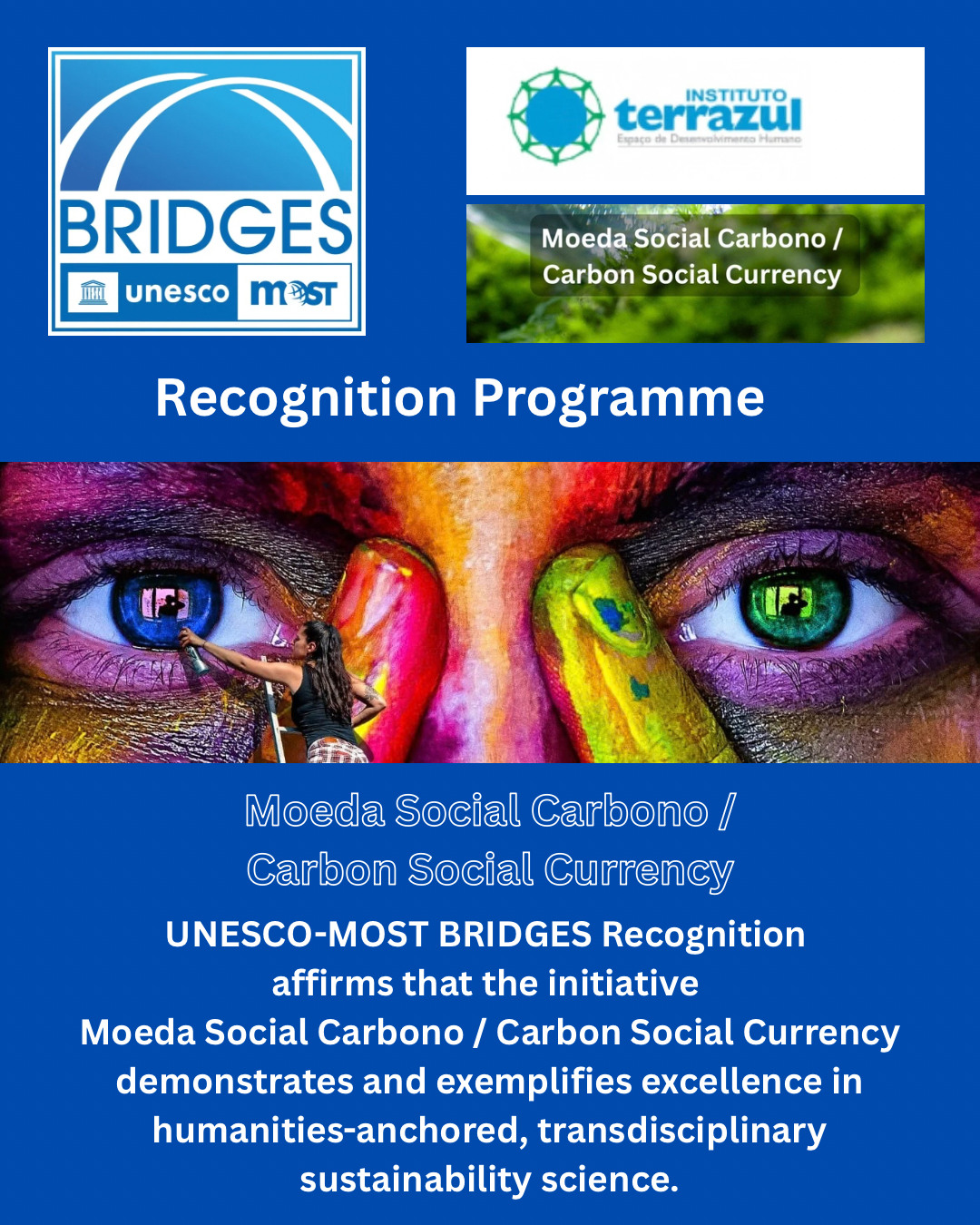
The UNESCO-MOST BRIDGES Coalition is proud to announce the formal recognition of Moeda Social Carbono / Carbon Social Currency, an initiative of the Terrazul Institute, as an outstanding example of humanities-anchored, transdisciplinary sustainability science.
This recognition follows a rigorous evaluation of the initiative’s alignment with BRIDGES’ principles, emphasising socially responsible, ethical, and transformative practice.
Moeda Social Carbono is a pioneering initiative rooted in the solidarity economy, climate justice, and community governance. It functions as a tool to convert concrete greenhouse gas (GHG) mitigation actions, such as reforestation and waste management, into carbon credits and, subsequently, into Brazilian reais.
Redefining Climate Finance through Community Governance
By financially rewarding the environmental stewardship of traditional communities (including indigenous peoples, artisanal fishermen, and family farmers), the program tackles the "socioeconomic invisibility" of those who preserve the planet but remain excluded from traditional climate finance.
“It allows for the measurement and monetization of real climate impacts at a local scale, making visible actions that currently go unnoticed."
Transdisciplinary innovation
A distinguishing feature of the initiative, aligning with the BRIDGES Coalition’s mission, is its foundation in the appreciation of local knowledge, contributing to local solutions to the climate crisis.
It functions as a collaborative ecosystem integrating:
Participating Partners include: Terrazul Institute (Leading Organisation); Banclima - Climate Bank; Local Municipalities; Research Centres; Local communities; Traditional peoples; and Civil Society Organisations.
Impact, Resilience, and "Territorial Pedagogy"
Through participatory planning and "territorial pedagogy," the initiative strengthens local resilience and provides a model for the productive inclusion of vulnerable territories. Its goals include:
Sustainable Development Goals (SDG’s)
This initiative serves as an exemplary case for bridging diverse knowledge bases to meet the Sustainable Development Goals (SDGs), specifically addressing: SDG 1 (No Poverty), SDG 8 (Decent Work and Economic Growth), SDG 10 (Reduced Inequalities), SDG 11 (Sustainable Cities and Communities), SDG 13 (Climate Action), and SDG 17 (Partnerships for the Goals).
A Methodology of Justice and Integrity
The initiative operates with social and environmental justice at its core, and is rooted in the following principles:
This initiative demonstrates that we cannot solve sustainability issues without understanding the social and cultural contexts that drive them. Rooted in these social and cultural contexts, it harnesses technology to strengthen solidarity economies and redistribute wealth to vulnerable territories; providing a powerful model of community resilience.
The work of Carbon Social Currency / Moeda Social Carbono strengthens the global UNESCO-MOST BRIDGES network and contributes meaningfully to transformative, humanities-anchored community-led initiatives.
We heartily congratulate Moeda Social Carbono / Carbon Social Currency on the official endorsement of BRIDGES recognition and commend their contribution to highlighting how the humanities can drive sustainability science to address modern environmental crises.
Affiliated Website Pages:
Terrazul Institute
Banclima - Climate Bank
BRIDGES Recognition: Are you working on a project that’s making a difference to local communities and our shared planet? Learn more about the BRIDGES recognition programme.