Posted in BRIDGES IPO news, News on Apr 28, 2026.
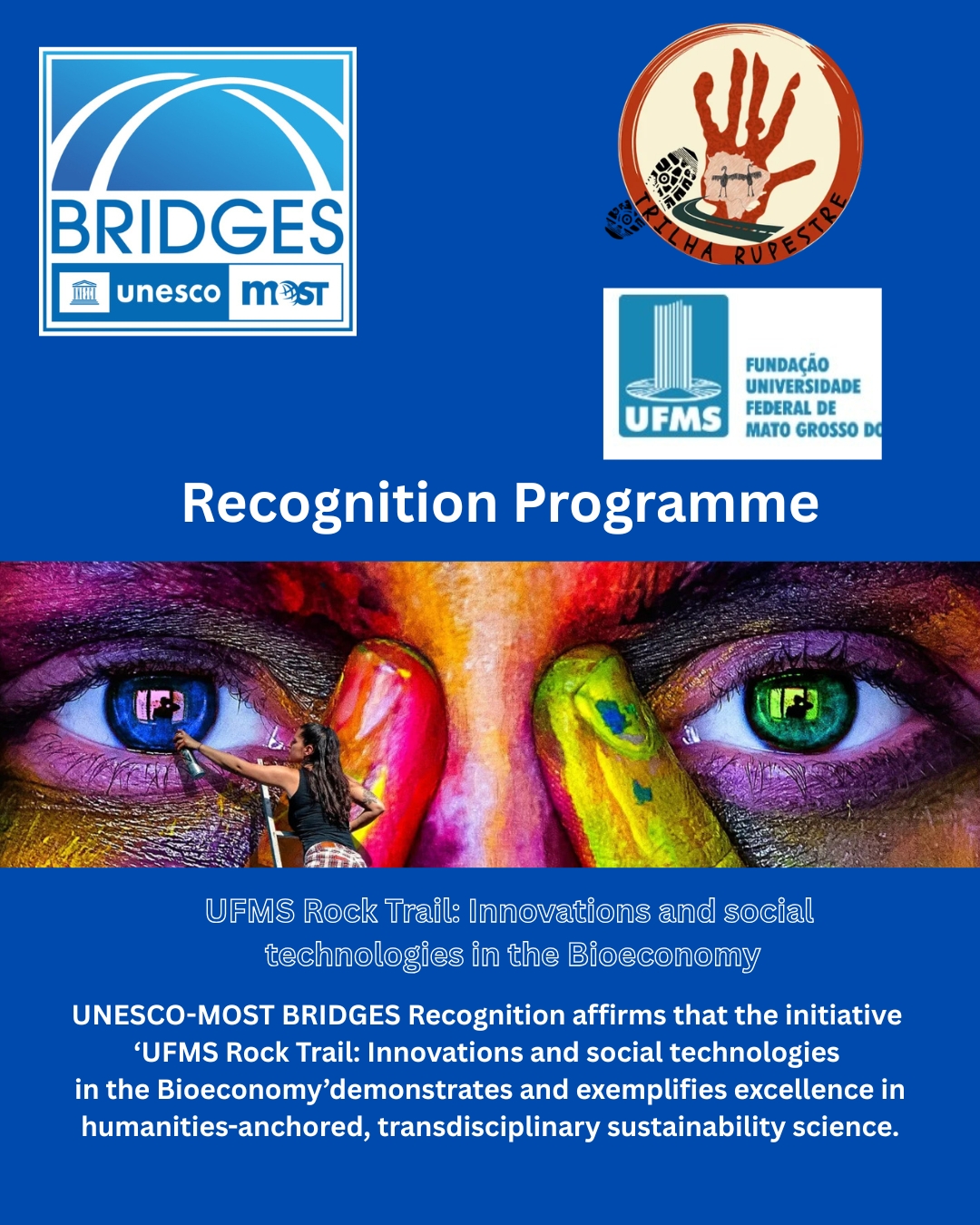
The UNESCO-MOST BRIDGES Coalition is proud to announce the formal recognition of ‘UFMS Rock Trail: Innovations and social technologies in the Bioeconomy’ as an outstanding initiative in humanities-anchored, transdisciplinary sustainability science.
This recognition follows a rigorous evaluation of the initiative’s alignment with BRIDGES’ principles, emphasising socially responsible, ethical, and transformative practice.
This social initiative stands as a leading example of how academic research can be woven into the fabric of local communities to foster sustainable territorial development, offering a "path of art, history, sustainability, technology and regional development.
Led by the Federal University of Mato Grosso do Sul (UFMS), this university extension initiative focuses on the valuation, preservation, and dissemination of the archaeological, paleontological, and natural heritage within the interior of Brazil, Mato Grosso do Sul, specifically in the Alcinópolis region.
Bridging the Invisible Gap
In the interior of Brazil, cultural and natural heritage often faces significant challenges, including invisibility, fragile conservation policies, and a lack of sustainable income for local communities. The Rock Art Trail initiative addresses these issues directly by transforming heritage sites into catalysts for social innovation and community leadership.
Transdisciplinary
The initiative is structured around a range of diverse yet interconnected thematic areas — archaeology, paleontology, bioeconomy, tourism, ceramics, botany, food, pharmaceutical chemistry, and architecture. Through this transdisciplinary structure the programme promotes educational, scientific, and cultural actions with a focus on social innovation, sustainability, and the popularization of science.
By integrating these diverse fields, the initiative works to strengthen regional identity and include traditionally marginalised territories in global scientific and cultural circuits.
A Dialogue of Knowledge
At the heart of the programme’s methodology is a continuous dialogue between academic science and ancestral knowledge. The project employs ethnographic approaches and critical pedagogy to ensure that rock art is understood not merely as a static archaeological object, but as a living ancestral language, whose preservation requires respect for local memories and practices. This process involves:
Artistic Mediations: Workshops with master craftsmen and sensory experiences.
Social Museology: Discussion groups with traditional communities to integrate local memories.
Digital Innovation: The use of augmented reality, georeferenced databases, and digital maps to make science accessible to the public.
Collaborative and Co-Created
The transdisciplinary nature of the programme allows for a complex, integrated understanding of the territory. The design of every action, from tourist routes to educational games, is co-created through public active listening sessions and participatory workshops. The choice of a transdisciplinary and participatory methodology is essential to guarantee social legitimacy, local appropriation, and the sustainability of the actions. By considering heritage as an educational, symbolic, and economic resource, the program promotes the community-based integration of preservation practices.
This effort is supported by a robust network of partners:
UFMS: Responsible for scientific and academic coordination.
FUNDECT: Providing essential financial partnership.
IPHAN: Acting as a technical partner for safeguarding and standardisation.
Local Protagonists: Teachers, tour guides, artisans, and family farmers from Alcinópolis and neighbouring municipalities who lead the execution of the thematic areas.
International Academia: Participation of global universities in scientific exchange and training.
Impact and Future Horizons
The Rock Art Trail initiative is currently in a phase of consolidation and expansion. Its impact is measured not just in academic papers, but in the generation of jobs within the bioeconomy and tourism sectors.
Sustainable Development Goals
By aligning with the UN Sustainable Development Goals (SDGs), specifically SDG 4: Quality Education; SDG 10: Reduced Inequalities; and SDG 11.4 Sustainable Cities and Communities; the programme ensures that millennia-old vestiges remain relevant for future generations.
The initiative also addresses several other SDG’s including SDG 8: Decent Work and Economic Growth; SDG 13: Climate Action; and SDG 17: Partnerships for the Goals.
Moving Forward
The team is seeking to broaden international support through organisations; especially those linked to culture, education, science and sustainable development, whilst developing a regional fund through intermunicipal consortia.
Through these strategic alliances, the initiative continues to prove that preserving the past is a fundamental step toward building a sustainable future.
Expected benefits for society
The benefits of the initiative occur at multiple levels:
Locally, the program contributes to strengthening creative and community economies, with job and income generation from activities such as handicrafts, tourist routes, production of traditional foods and provision of cultural services. The direct involvement of the population in the actions favors the appropriation of heritage assets and engagement in their protection.
Globally, the program aligns with the Sustainable Development Goals (SDGs) and the UNESCO agenda for the protection of tangible and intangible heritage. The intergenerational perspective is central: by preserving millennia-old vestiges and promoting their understanding by new generations, the initiative ensures that this cultural and environmental legacy is transmitted meaningfully and relevantly over time.
The work of ‘UFMS Rock Trail: Innovations and social technologies in the Bioeconomy’ strengthens the global UNESCO-MOST BRIDGES network and contributes meaningfully to transformative, humanities-anchored community-led initiatives.
We heartily congratulate ‘UFMS Rock Trail: Innovations and social technologies in the Bioeconomy’ on the official endorsement of BRIDGES recognition and commend their contribution to highlighting how the humanities can drive sustainability science to address modern socio-ecological issues.
Affiliated websites:
UFMS - Universidade Federal de Mato Grosso do Sul
Social Media: Instagram: @trilharupestre https://www.instagram.com/trilharupestre/
BRIDGES Recognition: If you are working on an initiative that undertakes innovative approaches to the co-creation of socio-ecological resilience in real-world contexts; our recognition programme could be an ideal fit. Discover more here.