Posted in BRIDGES IPO news, News on Feb 19, 2026.
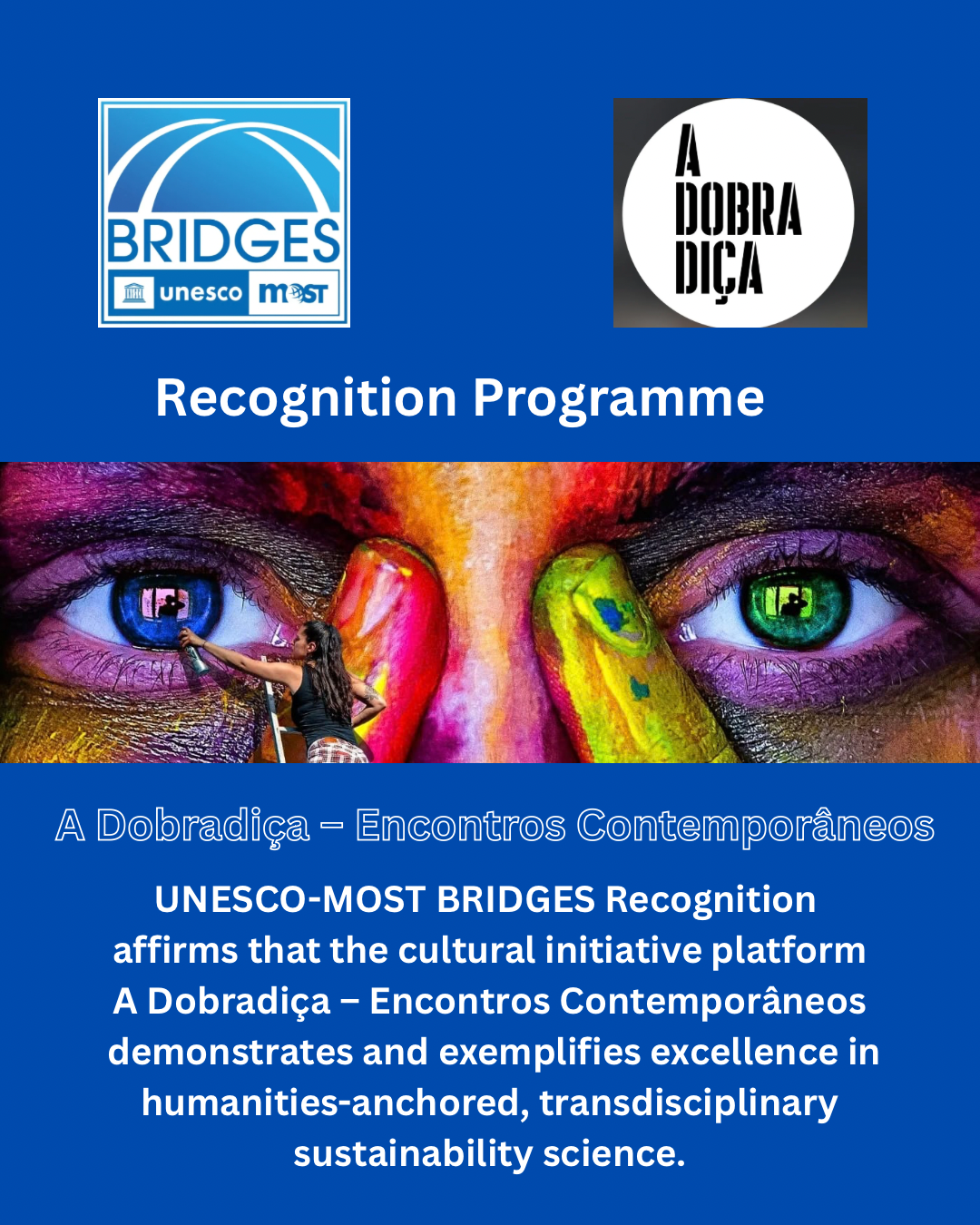
The UNESCO-MOST BRIDGES Coalition is proud to announce the formal recognition of A Dobradiça - Encontros Contemporâneos as an outstanding initiative in humanities-anchored, transdisciplinary sustainability science.
This recognition follows a rigorous evaluation of the initiative’s alignment with BRIDGES’ principles, emphasising socially responsible, ethical, and transformative practice.
Based in the rural Alentejo and Central regions of Portugal, A Dobradiça - Encontros Contemporâneos is a community-led initiative founded by artists Joana Rosa and Jabulani Maseko. A Dobradiça functions as a recurring biennale and cultural project, focussing on the intersection of visual arts, ecology, and scientific debate.
Concept and Framework
A Dobradiça; The "Hinge" Concept: Their mission is to act as a ‘living hinge’ between the past and the future, the human and the more-than-human, through art, land and community, and aims to cultivate belonging by repositioning rural life as central to ecological and cultural futures.
Philosophical Framework: "We Are Already Ecological": A Dobradiça believes that rural communities have lived in an ecological relationship with their land for centuries. They do not need to "become" ecological; they require the tools to protect and adapt that relationship in the Anthropocene.
A Collaborative Ecosystem: Transdisciplinarity in Action
Collaboration is at the heart of this initiative:
Through international collaboration with artists from the US, UK, Israel, and South Africa, the project creates a "global village" in Mação. A Dobradiça works with a constellation of partners, including the Institut Français, Goethe Institut, University of Coimbra, and the Mação Municipality, to foster global-local synergy and community resilience.
A Dobradiça provides a "hinge" between the lived, traditional knowledge of local populations and the specialised expertise of contemporary artists and scientists. This initiative treats local experience, artistic expression, and biological data as equal contributors. By providing access to contemporary tools like film and botany, the project empowers communities to narrate their own environmental reality. In doing so, it challenges the traditional boundaries that often separate urban academia and "city-centric" art from rural heritage.
An example can be seen in ‘The Observatory of Invasive Flora’ project which uses citizen science to map biodiversity threats like Acacia and wildfire risks. By pairing specialists with residents and filmmakers, the project captures the “emotional geography” of the landscape, recording the lived experience of fires and monocultures. When these films are screened in public squares, science becomes a community event. It turns raw data into a powerful story that helps us understand and protect our changing landscapes.
Core activities
Sustainable Development Goals (SDGs)
The initiative serves as an exemplary case for advancing global targets through culture-centred actions, specifically, SDG4: Quality Education; SDG5: Gender Equality; SDG8: Decent Work and Economic Growth; SDG10 Reduced Inequalities; SDG11: Sustainable Cities and Communities; SDG12: Responsible Consumption and Production; SDG13: Climate Action; SDG15: Life on Land; and SDG17: Partnerships for the Goals.
Environmental, Economic and Social Revitalisation
A Dobradiça operates on the premise that rural rebirth must be felt, lived, and woven through care. By redefining regional "abandonment" as the intertwined loss of economic vitality and ecological knowledge, it opens a space for "other ways of knowing." In addressing the narrative of rural abandonment, this initiative is catalysing both economic and social renewal. It demonstrates that rural communities and landscapes are hives of creativity and innovation, and a vital archive of ecological wisdom essential for our collective future.
The work of A Dobradiça - Encontros Contemporâneos strengthens the global UNESCO-MOST BRIDGES network and contributes meaningfully to transformative, humanities-anchored community-led initiatives.
We heartily congratulate A Dobradiça - Encontros Contemporâneos on their official BRIDGES recognition and commend their contribution to highlighting how the humanities can drive sustainability science to address modern environmental crises.
Affiliated website Pages:
Detailed Archive (Curator's Site): Cécile Bourne-Farrell – A Dobradiça
Institutional Page: Information is often shared via the Institut Français du Portugal and local Mação cultural networks.
Institut Français du Portugal
Social media:
Instagram: @ADobradiça
BRIDGES Recognition: Are you working on a project that’s making a difference to local communities and our shared planet? Learn more about the BRIDGES recognition programme.