Posted in ASU news, News, Summit Future News on Jun 03, 2026.
"Imagination is where responsibility begins."
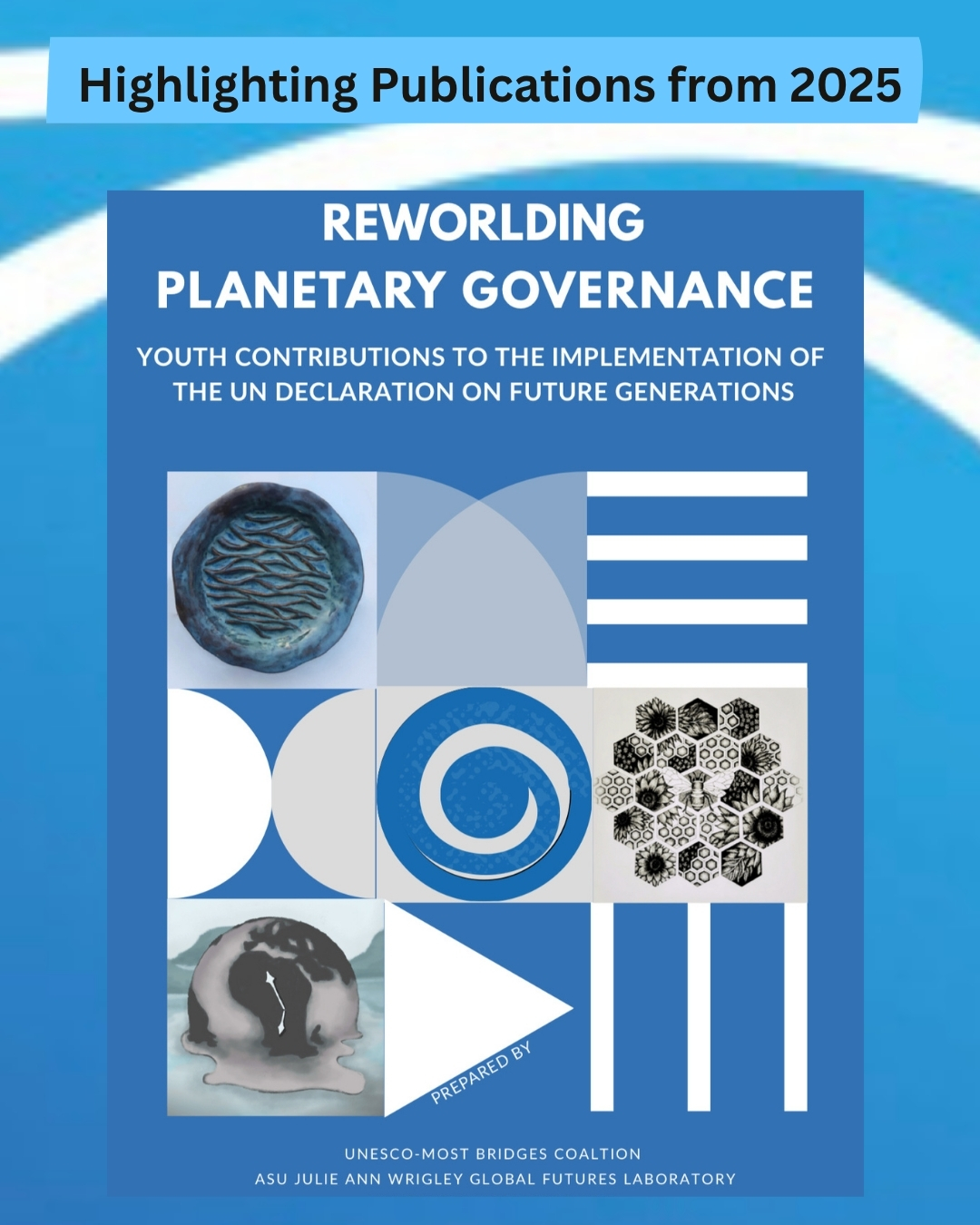
This report offers a refreshing, radical, and deeply moving alternative to an inevitably doomed future, where youth-led inquiry explores the possibility of "reworlding" our systems of governance through the power of collective imagination.
Prepared by UNESC0-MOST BRIDGES Coalition; ASU Julie Ann Wrigley Global Futures Laboratory and Learning Planet Institute, based on youth contributions arising from the ‘Learning for Planetary Citizenship and Anticipatory Governance’ UNESCO Futures Literacy Lab.
The publication, ‘Reworlding Planetary Governance’, synthesises the visionary outcomes of this Futures Literacy Lab held at UNESCO in Paris in March 2025. Bringing together students from Arizona State University, the Université Paris Cité/Learning Planet Institute, and young members of Je m’engage pour l’Afrique, the Lab challenged participants to design governance models fit for the realities of the 21st century and beyond.
Beyond the Human: A Shift in Perspective
At the heart of the report is a bold provocation: what if governance made space for those who have never been allowed to speak - rivers, trees, future generations, and the systemically unheard?
The participants engaged in a structured futures methodology, including systems mapping and Causal Layered Analysis. Through this process, they identified three essential shifts required to safeguard planetary futures:
Expanded Representation: Widening the circle of political stakeholders to include ecosystems, species, caregivers, and future generations.
Shifted Time Horizons: Treating time as an ethical boundary, holding today’s decisions accountable to the lifecycles and needs of generations yet to come.
Redefined Knowledge: Elevating care, lived experience, Indigenous wisdom, and more-than-human sensing alongside traditional technical expertise.
From Personas to Propositions
A compelling feature of the report is its use of "Future Personas" - a creative, design-led tool that allows participants to inhabit the perspectives of diverse beings, from an Orca whale to a "Homeless Planter." These personas act as living thought experiments, exposing the hidden spaces in our current systems and revealing how governance might function if designed through the eyes of those currently excluded from the political process.
These experiments gave rise to concrete, imaginative propositions:
Ecological Sentinel Systems: Governance that listens differently, where agreed-upon ecological thresholds (e.g., biodiversity loss or temperature spikes) trigger automatic political responses.
Guardianship: Legally mandated representation for nature, where guardians act on behalf of ecosystems with the power to intervene in planning processes.
Future Generations Assemblies: Standing bodies that review long-term policy, ensuring today’s decisions are held to the measure of tomorrow.
Infrastructures of Care: A move to reposition care - often treated as invisible or secondary - as the foundation of social and ecological resilience.
A Living Contribution
The report is not intended as a final, static document, but as a "living contribution" to the UN Pact for the Future. It is a vital resource for policymakers, educators, and civil society leaders tasked with implementing the Declaration on Future Generations.
By framing governance as a collective story - one that includes all voices, including the more-than-human world - this publication invites us to take bold action. If we don't dare to imagine, we surrender our ability to create the futures we want. This beautifully moving and pertinent publication empowers our collective imagination, inspiring us to work across generations, cultures, continents, and lifeforms towards a better tomorrow.
'Reworlding Planetary Governance' acts as a catalyst for inquiry, surfacing vital questions and new ways of seeing needed to build futures that flourish for all life.
What if the very act of learning could be planetary?
What if a university could be a place not only of knowledge, but of responsibility, reciprocity, and regeneration?
And what if governance made space for those who have never been allowed to speak—rivers, trees, future generations, and the systemically unheard?
Explore the report
We are not Waiting
As we move through 2026, youth engagement remains a top priority for the BRIDGES coalition. We are excited to collaborate with the youth-led platform, The 50 Percent, on our new initiative: We are not Waiting. This project features two key components: a youth-led webinar series and an accompanying anthology.
If you are aged between 14-35 and are involved in work to build a fairer, more sustainable future through community organising, social innovation, cultural work, technological creativity, or environmental stewardship - or if you know someone who is - we want to hear from you!