Posted in BRIDGES IPO news, News on Sep 28, 2026.
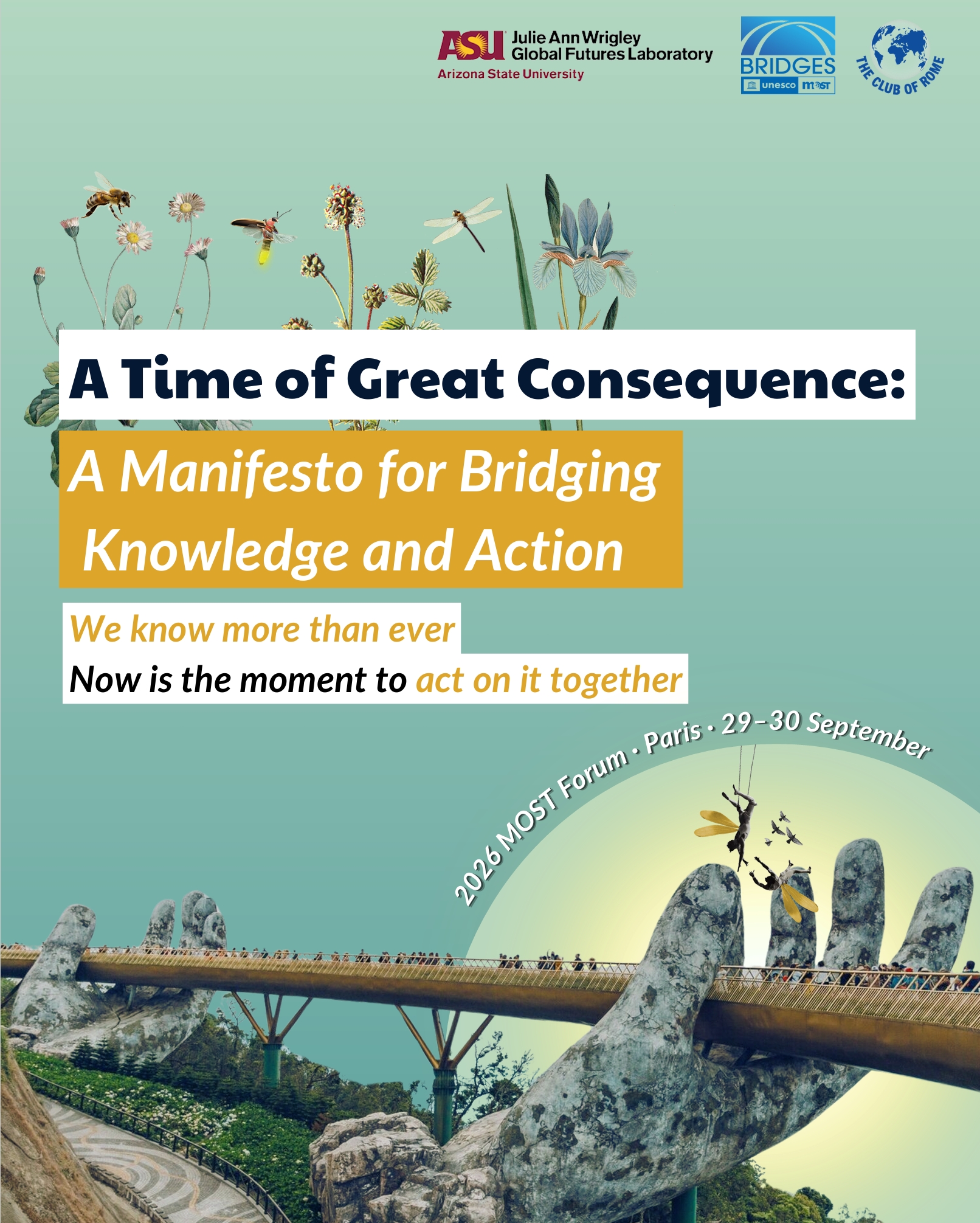
A group of leading scientists and scholars, authors, policymakers and institutions from across the world have endorsed A Time of Great Consequence: A Manifesto for Bridging Knowledge and Action, launched today by UNESCO-MOST BRIDGES, the Julie Ann Wrigley Global Futures Laboratory at Arizona State University and the Club of Rome.
The manifesto argues that humanity has never understood so much about the transformations reshaping the Earth system, nor anticipated their consequences so clearly, yet the world's collective response remains profoundly out of step with what is known. It traces this gap to economic inequality, social fragility, deepening political divisions, institutions increasingly out of step with today's realities, and knowledge itself that has become too fragmented to act on at the scale and with the urgency required.
The Manifesto asserts that there is nothing inevitable about this situation. Its central claim is that no single knowledge system, discipline or institution can meet the crises of this era alone. Meeting them requires bringing together the full spectrum of human knowledge, scientific, humanistic, cultural, Indigenous, professional and lived, and reorienting the institutions that connect knowledge with action.
“The barriers to knowledge are political, cultural and gendered, and for too long, that knowledge has been produced by a narrow circle and directed at everyone else. This manifesto names those barriers and commits us to placing the social sciences and humanities at the heart of how we govern, for the benefit of all.” said Najat Vallaud Belkacem, former minister for Education, France and an endorser of the manifesto.
The manifesto calls for:
• knowledge systems that work together rather than apart, bridging science, humanities, culture, Indigenous and lived knowledge to help humanity navigate an interconnected world
• the conditions for diverse communities to deliberate, learn and collaborate across their differences, building trust and shared purpose
• renewing institutions to learn with the people they serve, connecting knowledge with action and cultivating unrealized human capacities
“Future generations will judge us not by what we knew, but by what we did with that knowledge. This manifesto offers a compelling vision for bringing together diverse perspectives, strengthening our institutions and turning understanding into the collective action needed to build just and sustainable futures.” said Derek Walker, the Future Generations Commissioner for Wales and an endorser of the manifesto.
Endorsers of the manifesto include Jayati Ghosh, Professor of Economics at the University of Massachusetts Amherst and member of the Club of Rome, Carlos Lopes, Professor, Nelson Mandela School of Public Governance, University of Cape Town, and Janez Potocnik, Co-chair UNEP International Resource Panel, among other endorsements, spanning research, policy, civil society and international institutions.
The manifesto is published ahead of the 2026 MOST Forum, taking place in Paris on 29 and 30 September 2026, where policymakers, researchers and practitioners will begin translating its principles into a practical toolkit for policymakers. An accompanying policy framework has also been submitted with the Manifesto to the Intergovernmental Council of UNESCO's Management of Social Transformations programme ahead of its extraordinary session on 1 October.
Watch the MOST Forum Live here: https://webcast.unesco.org/events/2026-09-MOST/
The full text of the manifesto and the list of endorsers is available here.
The manifesto is launched ahead of the 2026 MOST Forum, taking place in Paris on 29–30 September 2026.
A Time of Great Consequence: A Manifesto for Bridging Knowledge and Action has been written by the BRIDGES Coalition in UNESCO's Management of Social Transformations (MOST) programme, the Julie Ann Wrigley Global Futures Laboratory at Arizona State University and the Club of Rome. It calls for a fundamental reorientation of how humanity learns in solidarity across knowledge systems, deliberates across differences and acts together with purpose and urgency.
“Within BRIDGES we regard the Earth not solely as a planetary system, nor as a reservoir of resources, but as a web of meanings and interactions that is inherently multilayered and pluralistic. This is why the humanities and social sciences are crucial to any understanding of socio-ecological resilience. Bridging knowledge systems is the first step from understanding to action.” – Steven Hartman, Founding Executive Director, UNESCO-MOST BRIDGES Coalition
“Human ingenuity has transformed our world, creating extraordinary progress alongside unprecedented challenges. Now we must summon that same ingenuity to confront the consequences of our actions. We must accept our collective responsibility and change course while we can — working toward a better future for people and planet.” – Peter Schlosser, University Vice President and Director General, Julie Ann Wrigley Global Futures Laboratory, Arizona State University
“The wisdom required to navigate our crises already exists everywhere, in the lived experiences of those on the frontlines. This manifesto is the choice, made in solidarity, to transform decision-making with that wisdom, as generations to come deserve.”– Carlos Álvarez Pereira, Secretary General, the Club of Rome
UNESCO-MOST BRIDGES UNESCO-MOST BRIDGES is a prioritised coalition within UNESCO's Management of Social Transformations (MOST) programme, the first humanities-inclusive, transdisciplinary sustainability science coalition within UNESCO, focused on the challenges set out in the UN Sustainable Development Goals. www.bridges.earth
Julie Ann Wrigley Global Futures Laboratory, Arizona State University The Julie Ann Wrigley Global Futures Laboratory at Arizona State University is a model for a university designed for the future of our planet. It brings together expertise across science, engineering, health, humanities and the arts to understand Earth as an interconnected system. With more than 960 faculty and scholars across 80 centers, it is among the most comprehensive planetary futures initiatives in higher education. The laboratory develops and scales solutions in energy, food systems, water, infrastructure and society to advance resilience, equity and long-term well-being. www.globalfutures.asu.edu
The Club of Rome The Club of Rome is a unique platform of over 150 thought leaders and changemakers from across geographies and sectors, catalysing system change since 1968. Its vision is a world that has moved beyond emergencies, with reimagined systems that support human capacities to deliver wellbeing for all on a peaceful and healthy planet. www.clubofrome.org