Posted in Club of Rome News, News on May 19, 2026.
Authors: Felix Rüdiger, Kaspar Köchli, Matthew Hunter, Nolita Thina Mvunelo.
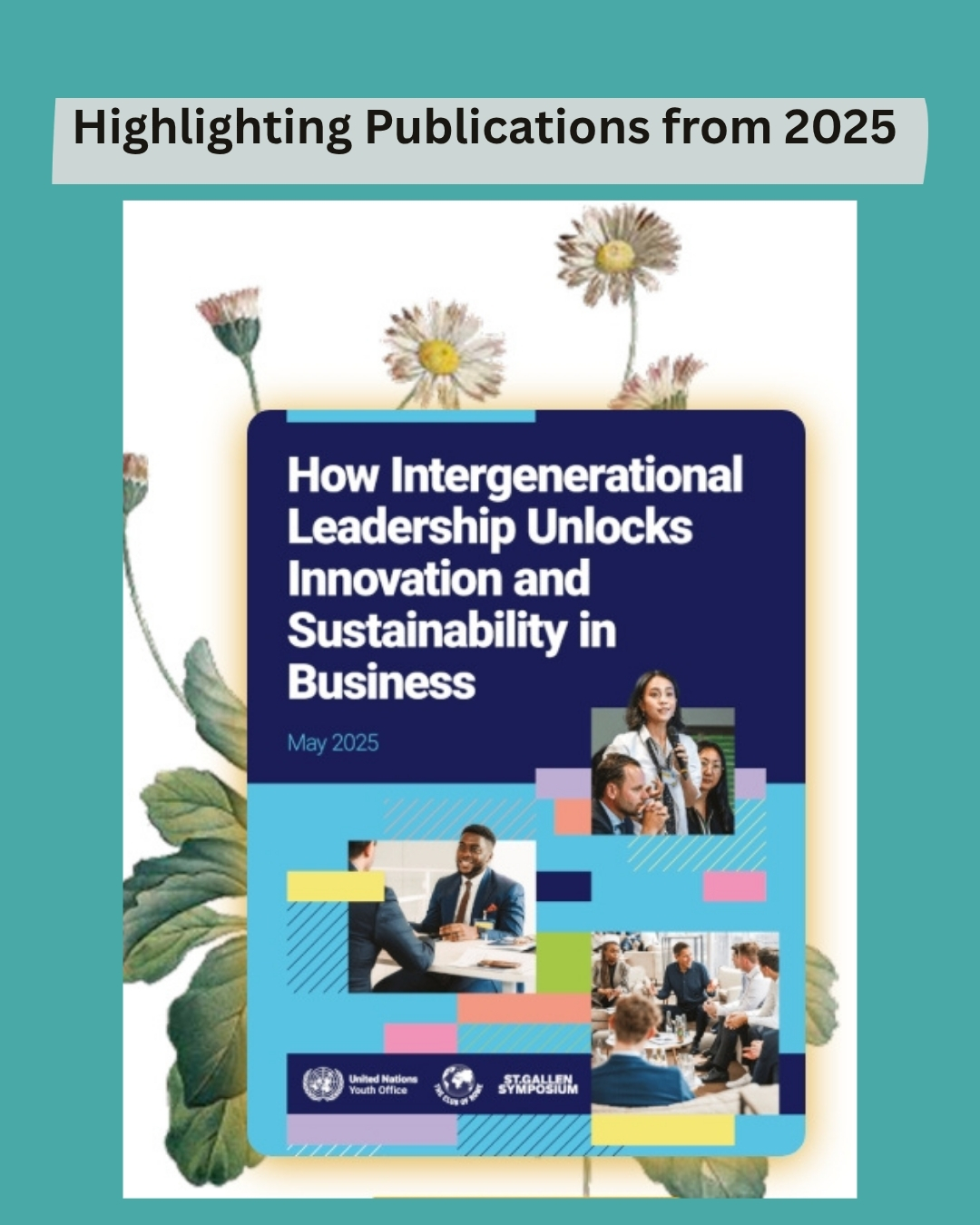
Continuing our series highlighting publications from 2025, we focus on a collaborative report that addresses the widening demographic and conceptual gap in global corporate leadership.
Published in May 2025 by the United Nations Youth Office, the St. Gallen Symposium, and The Club of Rome, this report makes a compelling case for a fundamental shift in how power and wisdom are distributed within organisations.
It argues that involving younger generations meaningfully in decision-making across all levels of an organisation creates forward-thinking institutions that are more responsive to the complex challenges facing the world today, while also ensuring long-term sustainability.
Bridging the Generational Divide
The publication begins by highlighting a stark reality: while the median age of the global workforce is 39.6 years, the average age of a CEO remains significantly higher at 56.8. This gap, the authors argue, often results in "short-termism" and a reliance on outdated business models that are ill-equipped to handle the "polycrisis" of climate change, social inequality, and rapid technological disruption.
The report frames youth inclusion as a strategic imperative. By integrating the fresh insights of younger generations with the established experience of senior leaders, businesses can move beyond traditional extraction-based goals toward more regenerative, long-term thinking.
Key Dynamics of Intergenerational Leadership
The report identifies five transformative benefits that emerge when organisations embrace a cross-generational approach:
Empathy and Relational Value: Enhancing the connection between a diverse workforce and an equally diverse customer/client base.
Long-term Strategic Thinking: Shifting the focus from quarterly profits to intergenerational justice and planetary health.
Disruption of Outdated Practices: "Overcoming the success trap". Challenging "the way things have always been done" through the introduction of new paradigms and digital fluencies.
Creative Problem-solving: Leveraging generational diversity to spark innovation in sustainability and circularity.
Enhanced Governance: Building accountability structures that consider the impacts of today’s decisions on future stakeholders.
Moving from Theory to Action
To help organisations navigate this transition, the publication outlines three practical pathways for implementation:
Consultation: Moving beyond surveys to active mechanisms like reverse mentoring and youth advisory boards.
Co-leadership: Integrating younger voices directly into executive decision-making structures and boardrooms.
Organisational Integration: Building an inclusive culture through everyday practices. Ensuring that intergenerational collaboration is not a one-off project but a core cultural value embedded in recruitment and promotion.
Implications for the Future
As we navigate the mid-2020s, this report serves as a useful tool for knowledge producers and policymakers alike. For the BRIDGES community, we share the core values and echo the commitment to transdisciplinary, inclusive approaches. It underscores that the lived experiences and insights of all voices are essential for reimagining society as a site of collective care and ecological responsibility.
At BRIDGES, we share this commitment to centring youth voices, which serves as a core focus of our Strategy 2026–2028. By placing intergenerational equity at the heart of governance, we can move towards a world where progress is measured by the wellbeing of the world we leave behind.
“This report challenges the outdated notion that leadership must come with age,” said Nolita Thina Mvunelo, Programme Manager at The Club of Rome and a co-author of the report. “True resilience in business will come from the courage to reimagine decision-making as a space where wisdom and fresh insight meet.”
Felix Rüdiger, Head of Content & Research at the St. Gallen Symposium and co-author, added: “Intergenerational leadership isn’t just a better way forward—it’s essential for shaping a future that works for everyone.”
Access this Publication: How Intergenerational Leadership Unlocks Innovation and Sustainability in Business.