Posted in BRIDGES IPO news, News on Apr 21, 2026.
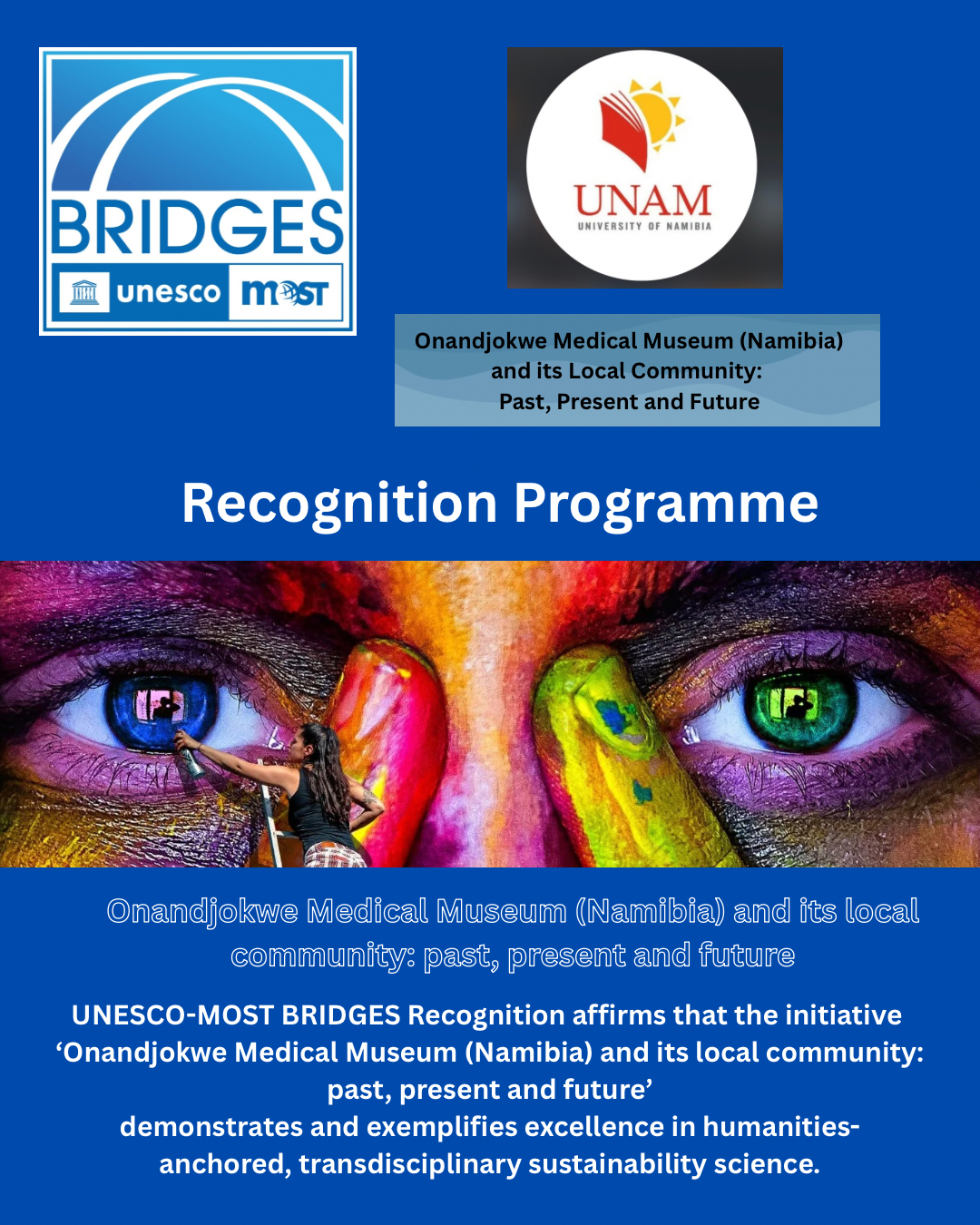
The UNESCO-MOST BRIDGES Coalition is proud to announce the formal recognition of ‘Onandjokwe Medical Museum (Namibia) and its local community: past, present and future’ as an outstanding initiative in humanities-anchored, transdisciplinary sustainability science.
This recognition follows a rigorous evaluation of the initiative’s alignment with BRIDGES’ principles, emphasising socially responsible, ethical, and transformative practice.
By integrating Cultural Heritage Management, Medical History, and Museology, the initiative fosters collaboration between the Onandjokwe Hospital and the local community to promote Indigenous medical knowledge systems.
Background
Founded in 2012, the Onandjokwe Medical Museum holds the distinction of being the first and only medical museum in Namibia. The museum is housed in a historic building constructed between 1908 and 1911 by Selma Rainio, a Finnish doctor. This structure originally served as the first hospital in north-central Namibia, making the site a cornerstone of the region’s clinical history.
While the museum was established to showcase the medical evolution of Onandjokwe and the broader country, it currently faces challenges in maintaining relevance to the local community. To address this, the University of Namibia (UNAM) has initiated a project to revitalize the museum through community-led co-design and interdisciplinary collaboration.
Aims and Objectives
The overarching goal of this initiative is to foster collaboration between the Onandjokwe Hospital and the local community while promoting Indigenous medical knowledge systems.
Key objectives include
Partnership and Methodology
Organisation Lead: University of Namibia (UNAM)
Project Leads: Dr. Emma Haitengi and Professor Napandulwe Shiweda.
Dr. Emma Haitengi brings expertise in cultural heritage management, history, and archaeology, while Professor Napandulwe Shiweda specialises in public and visual history, tourism, and museum studies.
The project follows a collaborative, phased approach:
Phase One: Team Formation: The creation of a team comprising academics, local herbalists, community leaders, museum staff, and medical practitioners.
Phase Two: Documentation: Data collection through interviews and research into the medical properties and cultural significance of local herbs.
Community Engagement
The project utilises focus groups and interviews with stakeholders, including traditional authorities, to ensure academic thinking is influenced by local knowledge and vice versa.
Sustainable Development Goals
The project aligns with several United Nations Sustainable Development Goals (SDGs) identifying two specific SDGs as central to its mission: SDG 11: Sustainable Cities and Communities - specifically 11.4 Strengthening efforts to protect and safeguard the world’s cultural and natural heritage; and SDG 3: Good Health and Wellbeing.
These SDGs are addressed by co-designing the museum’s future with the local community. This ensures that the safeguarding of history (SDG 11.4) directly supports the community's contemporary health and knowledge systems (SDG 3).
Other SDG’s addressed by the initiative include: SDG 4: Quality Education; SDG 10: Reduced Inequalities; and SDG 17: Partnerships for the Goals.
Value and Expected Impact
There is currently a significant research gap regarding the impact of museums on Namibian society. This initiative seeks to fill that gap by documenting how community involvement in co-designing exhibits and educational content can increase a museum's social value.
Expected outcomes include:
Restoration and Visualisation: A clear roadmap for the physical restoration of the historic building and updated visual displays.
Educational Content: Co-designed layouts for the museum and herb garden that reflect the community's contribution.
Sustainable Partnerships: Ongoing collaboration between the museum, local schools, cultural institutions, and healthcare providers.
Cultural Awareness: Increased awareness of traditional medicines and the safeguarding of local Indigenous Knowledge.
The work of 'Onandjokwe Medical Museum (Namibia) and its local community: past, present and future' strengthens the global UNESCO-MOST BRIDGES network and contributes meaningfully to transformative, humanities-anchored community-led initiatives.
We heartily congratulate 'Onandjokwe Medical Museum (Namibia) and its local community: past, present and future' on the official endorsement of BRIDGES recognition and commend their contribution to highlighting how the humanities can drive sustainability science to address societal concerns such as safeguarding cultural and natural heritage, health, and wellbeing.
Affiliated Websites:
Note: The initiative is currently in a developmental stage. Realising these goals, including the improvement of the exhibition and the expansion of the medicinal herb garden, requires further funding for logistics and implementation.
BRIDGES Recognition: Are you working on a project that’s making a difference to local communities and our shared planet? Learn more about the BRIDGES recognition programme.