Posted in BRIDGES IPO news, News on Feb 13, 2026.
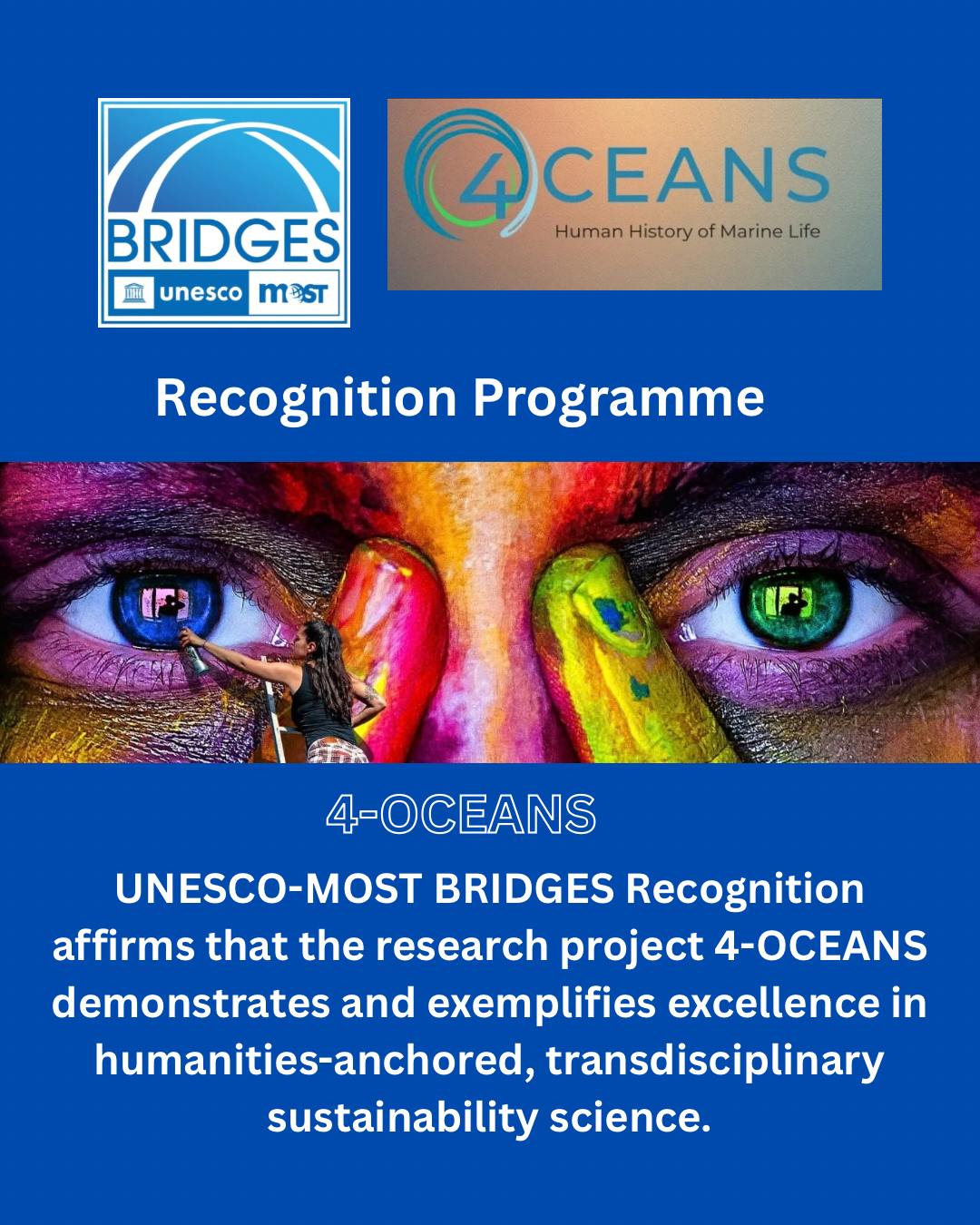
The UNESCO-MOST BRIDGES Coalition is proud to announce the formal recognition of the 4-OCEANS research project as an outstanding initiative, demonstrating and exemplifying excellence in humanities-anchored, transdisciplinary sustainability science.
4-OCEANS is a historical research project that explores how marine ecosystems and human societies have shaped each other over centuries, producing a global, data-rich understanding of the long-term dynamics of marine life and human development and provides critical insights for sustainable ocean management, conservation strategies and policy making.
UNESCO-MOST BRIDGES recognition follows a rigorous evaluative process assessing alignment with UNESCO-MOST BRIDGES’ principles and UNESCO’s sustainability science approach, with particular emphasis on transdisciplinary, socially responsible, ethical and transformative practice.
Led by the Trinity Centre for Environmental Humanities (TCD), this ambitious six-year endeavour exemplifies the BRIDGES mission to address the pressing ecological and societal challenges of our time.
A 2,000-Year Perspective on Sustainability
"How did marine life affect and alter societies of the past?" This is one of the key questions the EU-funded 4-Oceans project will seek to answer by investigating the importance of marine life for human societies. Funded by a €10.4 million European Research Council (ERC) Synergy Grant, the mission of 4-OCEANS is to conduct the first-ever global assessment of how marine life has shaped human societies over the last two millennia (100 BCE to 1860 CE).
4-OCEANS looks back twenty centuries to understand the "marine event horizons" that have defined human development. The project explores how selected socio-economic, cultural, and environmental forces, have both enabled and limited the harvest of the sea.
Transdisciplinarity in Action
4-OCEANS is built on a robust transdisciplinary framework, uniting a diverse team of experts. Bringing together expertise from marine environmental history, climate history, natural history, geography, historical ecology, genomics and zooarchaeology, to investigate the long-term consequences of marine resource exploitation, the project provides a vital historical baseline for modern ocean governance.
4-Oceans collaborates with partners, NASA Space Agency; Columbia University; University of Oslo; University of Texas, Arlington; and University of California, San Diego. 4-Oceans works directly with OBIS, Oceans biodiversity information system and OPI, Oceans Past Initiative. Through Trinity College Dublin, 4-OCEANS is an accredited stakeholder of UN 2025 United Nations Ocean Conference.
Sustainable Development Goals
4-OCEANS serves as an exemplary case of how bridging diverse knowledge systems can provide innovative solutions to the UN Sustainable Development Goals; attending to SDG 4: Quality Education; SDG 12: Responsible Consumption and Production; SDG 13: Climate Action; SDG 14: Life Below Water; and SDG 17: Partnerships for the Goals.
Global Reach and Policy Impact
The 4-OCEANS project is currently developing a World Atlas of Historical Marine Exploitation, designed to inform the UN Decade of Ocean Science for Sustainable Development.
By illustrating our "shared ocean legacy," the researchers, led by Principal Investigators, Poul Holm and Francis Ludlow (Trinity College Dublin) James Barrett (NTNU, Trondheim) and Cristina Brito (NOVA, Lisbon), aim to shift how citizens and policymakers value marine life. The project demonstrates that the ocean has never been a static background to human history, but rather a dynamic driver of societal resilience and transformation.
The principal investigators will apply a methodology of systematic review and meta-analysis. They will ask, "what were the consequences of marine exploitation?" Ultimately, their discoveries and outputs, including the digital World Atlas of Historical Marine Exploitation, “will influence virtually every humanities-and science-based discipline touched by the sea.” They will also inform the UN Decade of Ocean Science.
The work of 4-OCEANS strengthens the global UNESCO-MOST BRIDGES network and contributes meaningfully to transformative, humanities-anchored community-led initiatives.
We heartily congratulate 4-Oceans on the official endorsement of BRIDGES recognition and commend their contribution to highlighting how the humanities can drive sustainability science to address modern environmental crises.
Project websites:
https://www.tcd.ie/tceh/4-oceans/
https://www.ntnu.edu/museum/4-oceans
https://cham.fcsh.unl.pt/en/projects-detail.php?p=2069
Social media:
Instagram and X @4oceanserc
BRIDGES Recognition: If you are working on an initiative that undertakes innovative approaches to the co-creation of socio-ecological resilience in real-world contexts; our recognition programme could be an ideal fit. Discover more here.