Posted in Club of Rome News, News on Feb 25, 2026.
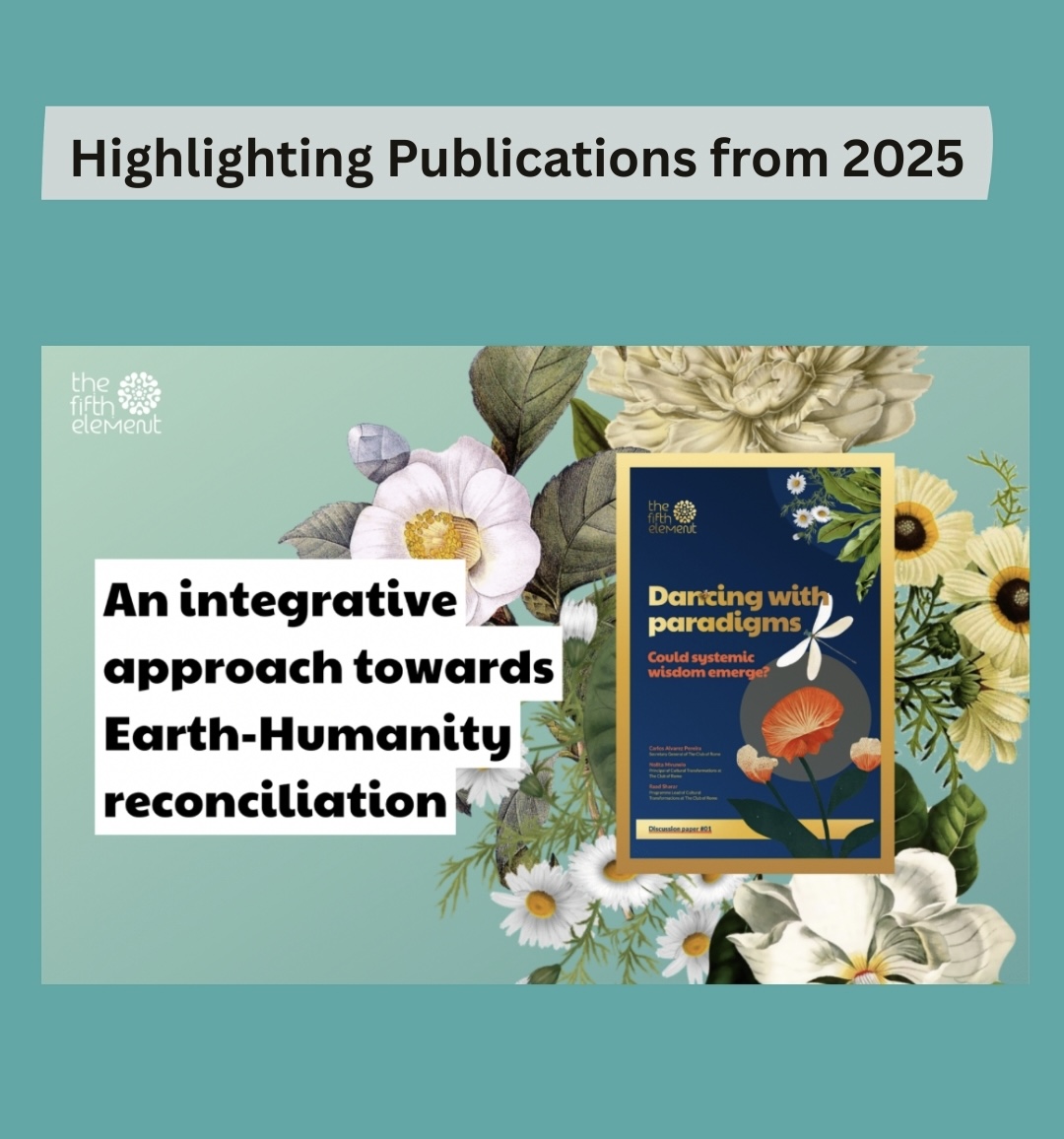
Highlighting Publications: Dancing with Paradigms—Could Systemic Wisdom Emerge?
Authors: Carlos Alvarez Pereira, Secretary General of the Club of Rome, Nolita Thina Mvunelo, Principal of Cultural Transformations at the Club of Rome and Raad Sharar, Programme Lead of Cultural Transformations at the Club of Rome. Published 9 September 2025.
Continuing our series highlighting publications from 2025, we focus on a paper that challenges the conventional pursuit of "solutions" and instead invites a deeper inquiry into the questions we ask about our future, taking us through how systemic transitions can happen.
The Fifth Element, a flagship programme of The Club of Rome, which anchors The Club of Rome’s BRIDGES Hub, launched its inaugural discussion paper series last year, aimed at redefining how we approach global transformation.
The first publication of this series: An integrative approach towards Earth-Humanity reconciliation. “Dancing with paradigms, could systemic wisdom emerge?” asks us to consider, “What’s more powerful than answers? Asking better questions.”
The Fifth Element believe “new questions open the door to new possibilities. They help us see what’s been overlooked — the hidden gaps holding back transformation.”
Redefining the Search for Change
In an era defined by climate disruption, social inequality, and fractured governance, the paper argues that the very systems shaped by modernity are often the drivers of the crises they attempt to solve.
Starting with key questions, the paper explores how transformation requires embracing multiple perspectives, holding complexity without simplifying it, and fostering dialogue across divides.
The Fifth Element programme is driven by deep learning and mutual transformation.
Building on the legacy of No Limits to Learning, published by The Club of Rome in 1979, the challenge is to “rethink what we mean by systems change.”
Key Themes of the Publication
The paper serves as a foundational text for a series designed to foster "deep learning" and "mutual transformation." It highlights several critical shifts in perspective:
Taking a deep dive into different yet interconnected spheres, the paper offers a different angle of reflection, designed to foster deeper learning, beyond what conventional frameworks allow.
“Many past efforts have failed to create deep change. By asking better questions, we challenge old assumptions and explore new pathways for human development.”
An Invitation to Dialogue
This publication is not intended to be a final answer but an open invitation to "fellow explorers." It bridges ancient wisdom with contemporary scientific understanding, seeking what the authors term “planetary reconciliation”, the healing of our relationships with ourselves, each other, and the living world.
As part of the BRIDGES Coalition, which emphasises humanities-led sustainability science, the work of The Fifth Element underscores the necessity of cultural transformation as the bedrock of any successful systemic transition.
If you’re looking to understand how we move from isolated systems to regenerative networks, this paper is essential reading. It goes beyond theory, calling on readers to engage with the core drivers of change and help build a future where society and nature finally align.
“Some questions are not meant to be “solved” but lived.”
Further information and the discussion paper can be accessed here: New discussion paper: An integrative approach towards Earth-Humanity reconciliation | Club of Rome | The Fifth Element
Visit the fifth elements website.