Posted in Publications on Jun 30, 2025.
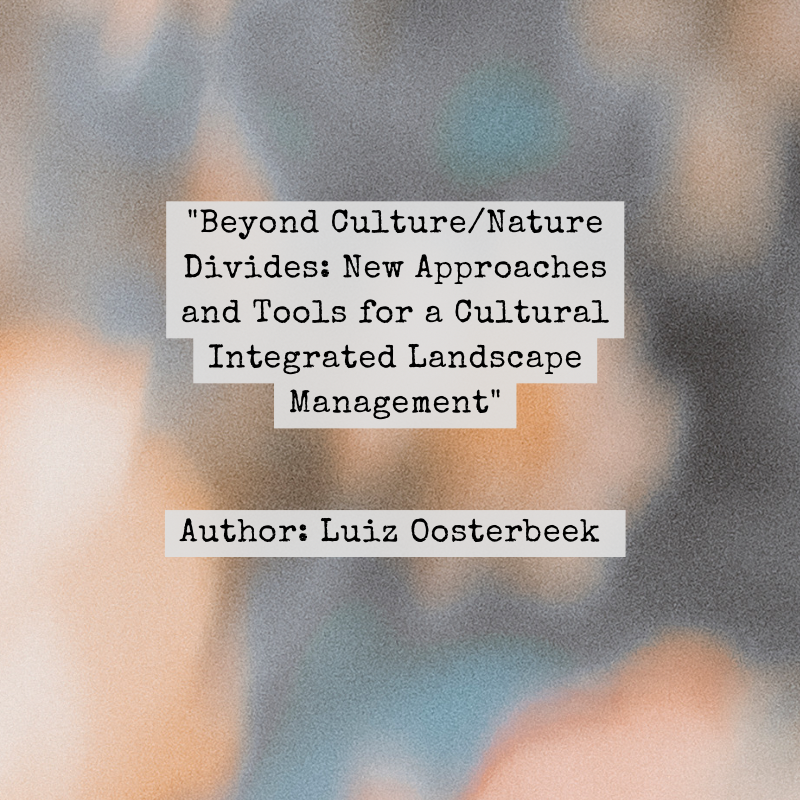
"Beyond Culture/Nature Divides: New Approaches and Tools for a Cultural Integrated Landscape Management" by Luiz Oosterbeek (published in Diversity, June 2025)
Overview
The paper re-examines the traditional dichotomy between nature and culture, arguing that effective natural resource management and biodiversity preservation must bridge this divide. It proposes a unified methodological framework centred around cultural landscapes to address contemporary environmental and sustainability challenges.
Key Themes and Structure
Deconstructing the Nature-Culture Divide: The paper explores historical and contemporary debates surrounding the concept of "nature" and its counterpart, "non-nature" (culture). It draws on perspectives ranging from antiquity and traditional/indigenous understandings to late 19th-century European frameworks. Methodological Framework from Past Societies: The author explores the systematisation of the primary variables used in studying past societies, translating them into a functional methodological tool for analysing and managing contemporary landscapes. Materialities and Perceptions: A significant section explores how material elements interact with human perceptions. By incorporating time- and space-driven approaches, the paper redefines cultural landscapes as dynamic systems shaped by this interplay between physical reality and human cognition. Perceived Nature and Case Studies: The latter part of the study characterises the key drivers behind the perception of nature as a cultural landscape, supported by two contemporary case studies.
Core Conclusion
Sustainable resource management cannot treat biodiversity and cultural diversity as separate entities. Instead, ecological conflicts and debates should be reframed within an integrated cultural landscape framework that values both ecological health and human context, supported by education and targeted management tools.