Posted in News, Publications, UWTSD Hub News on Sep 25, 2026.
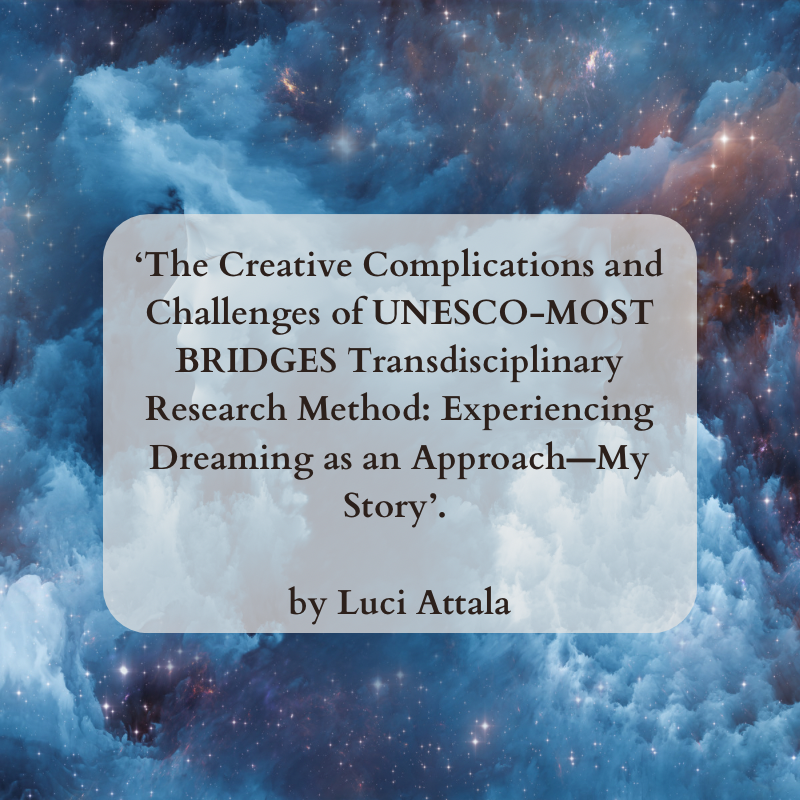
‘The Creative Complications and Challenges of UNESCO-MOST BRIDGES Transdisciplinary Research Method: Experiencing Dreaming as an Approach—My Story’. Author: Luci Attala
Among contributions to the publication Bridging History and Policy: Essays on Resilience, Sustainability and Systems Modelling is a chapter by BRIDGES Prof. Luci Attala titled ‘The Creative Complications and Challenges of UNESCO-MOST BRIDGES Transdisciplinary Research Method: Experiencing Dreaming as an Approach—My Story’.
This chapter highlights alternative methodologies like dreaming and Indigenous knowledge systems, challengeing traditional academic hierarchies and advocates for genuine, equitable co-design that reconfigures how we understand human-environment relationships.
TH-iSS framework
Prof Attala begins by providing an overview of UNESCO-MOST BRIDGES, exploring its framework—a transdisciplinary, humanities-informed sustainability science methodology (TH-iSS) operating under UNESCO.
She discusses the complications of transdisciplinary research asserting that true collaboration requires epistemic justice, shared decision-making, and mutual reflexivity. Advocating for equitable, long-term partnerships that integrate local and Indigenous wisdom to foster more-than-human flourishing.
Dreaming as a Research Methodology
The second half of the chapter presents a personal narrative examining the role of dreams as legitimate, non-rational knowledge systems in Indigenous research. Luci’s story demonstrates how alternative methodologies like dreaming can bridge cultural divides, open unexpected pathways for dialogue, and profoundly reshape academic research relationships.
Reimagining Research
To solve today's environmental and social crises, standard research tools are not enough; research practices need a major overhaul. The chapter strongly advocates for fair, genuine co-design. Ultimately, it emphasises that welcoming creative challenges—including subjective and non-Western approaches like dreaming—is essential, not a distraction, for building sustainable systems that connect humans and the environment.
You can access this paper directly here.
From the publication Bridging History and Policy: Essays on Resilience, Sustainability and Systems Modelling edited by John F. Haldon, Director of the BRIDGES Thematic Hub, CUNY-Princeton and Ricardo Fernandes, Max Planck Institute of Geoanthropology. Publisher Springer Cham.