Posted in News, Publications on Sep 02, 2026.
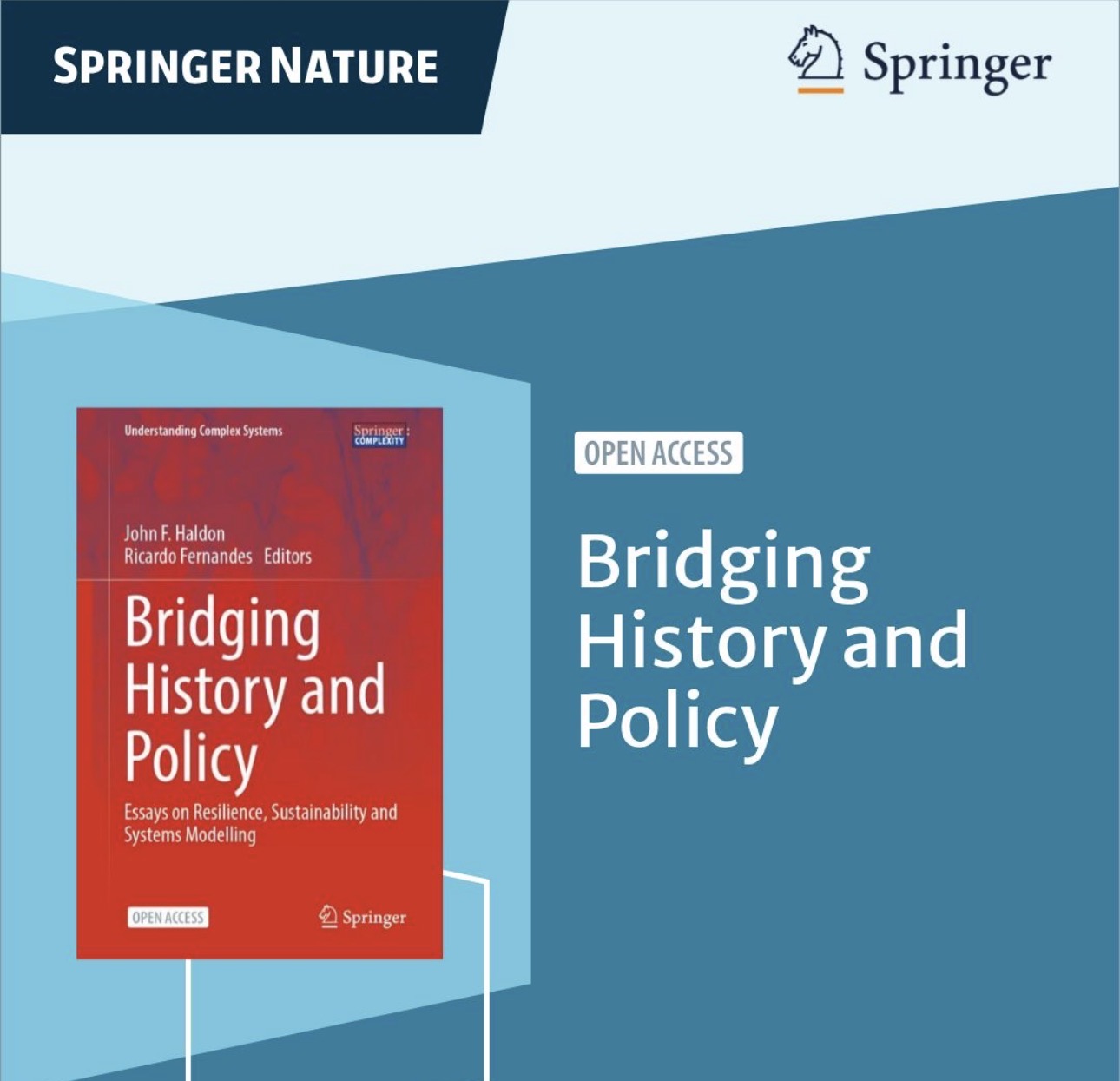
Bridging History and Policy: Essays on Resilience, Sustainability and Systems Modelling
Editors: John F. Haldon, Ricardo Fernandes
Open Access. Published 2026 by Springer Nature. Part of the book series: Understanding Complex Systems (UCS)
This open-access volume addresses critical hurdles in scale, systemic complexity, information exchange, systems modelling, and policy applicability. Its primary objective is to enhance the real-world utility of academic findings by bridging history, computational systems modelling, and governance.
Drawn from scholarly papers presented at twin colloquia held in 2023 and 2024, hosted respectively at the Max-Planck Institute for Geoanthropology and Princeton University, the publication champions robust cross-disciplinary collaboration to confront contemporary global issues.
The Creative Complications and Challenges of UNESCO-MOST BRIDGES Transdisciplinary Research Method: Experiencing Dreaming as an Approach—My Story. Luci Attala
Among these contributions, is a chapter by BRIDGES Dr. Luci Attala exploring the creative complications of transdisciplinary research. Highlighting alternative methodologies like dreaming and Indigenous knowledge systems, her work challenges traditional academic hierarchies and advocates for genuine, equitable co-design that reconfigures how we understand human-environment relationships. You can access this paper directly here: https://link.springer.com/content/pdf/10.1007/978-3-032-24379-9_8.pdf?pdf=inline%20link
Integrating Perspectives to Address Modern Crises
By synthesising insights from historians, archaeologists, complex systems modelers, and sustainability professionals, the volume generates practical knowledge to guide policies targeting pressing modern challenges, including:
Because conducting real-world experiments on massive socio-environmental systems is unfeasible and ethically problematic, historical documentation acts as vital observational evidence. History exposes recurring trajectories of societal endurance and failure, offering crucial lessons for current strategies.
Contributors examine the specific historical datasets and proficiencies required to refine systems modelling and improve its value for policy design.
A central theme involves applying complex systems theory alongside historical evidence to decode interactions across climatic, social, political, economic, and technological spheres. Writers investigate the theoretical foundations and methodological tools necessary to foster sustainable growth, narrow socio-economic divides, and avert systemic failures.
Advanced Techniques and Collaborative Platforms
The interdisciplinary exploration highlights advanced modelling methods and the expanding influence of artificial intelligence and machine learning. Furthermore, the volume focuses on designing cooperative research platforms essential for:
Ultimately, this volume serves as an essential guide for policymakers, computational modellers, and historical researchers eager to utilise multidisciplinary frameworks to resolve present-day challenges.
Access this publication: https://link.springer.com/book/10.1007/978-3-032-24379-9